A Constitutional Principle Becoming a Casualty
Article 9 of Japan’s postwar constitution is among the most explicit legal prohibitions on state violence ever written into a governing document. Japan renounced war as a sovereign right. It renounced the threat or use of force as a means of settling international disputes. For nearly eight decades, that clause functioned as the legal skeleton of a regional security arrangement underwritten by American power.
Defence Minister Shinjiro Koizumi’s statement to the BBC — that Japan must abandon its pacifist posture because doing so is ‘critical’ to preventing war — does not represent a shift in policy. It represents the public acknowledgment that the conditions which made Article 9 viable no longer exist.
The Architecture Being Dismantled
The postwar Pacific order rested on a specific bargain: Japan would cap its military ambitions, and the United States would provide the deterrent umbrella. That arrangement kept Japanese rearmament politically invisible to Tokyo’s neighbors, most of whom carry generational memory of Imperial Japan’s conduct on the continent.
The bargain is unraveling from both ends simultaneously. Washington’s appetite for open-ended security guarantees has become visibly conditional under successive administrations. Beijing has expanded its naval footprint, its missile inventory, and its willingness to conduct pressure operations against Taiwan with a consistency that cannot be attributed to any single American administration’s posture. Pyongyang’s nuclear and ballistic missile capabilities have matured past the point where regional defense planners can model them out of their threat assessments.
Koizumi is not announcing a preference. He is narrating a fait accompli.

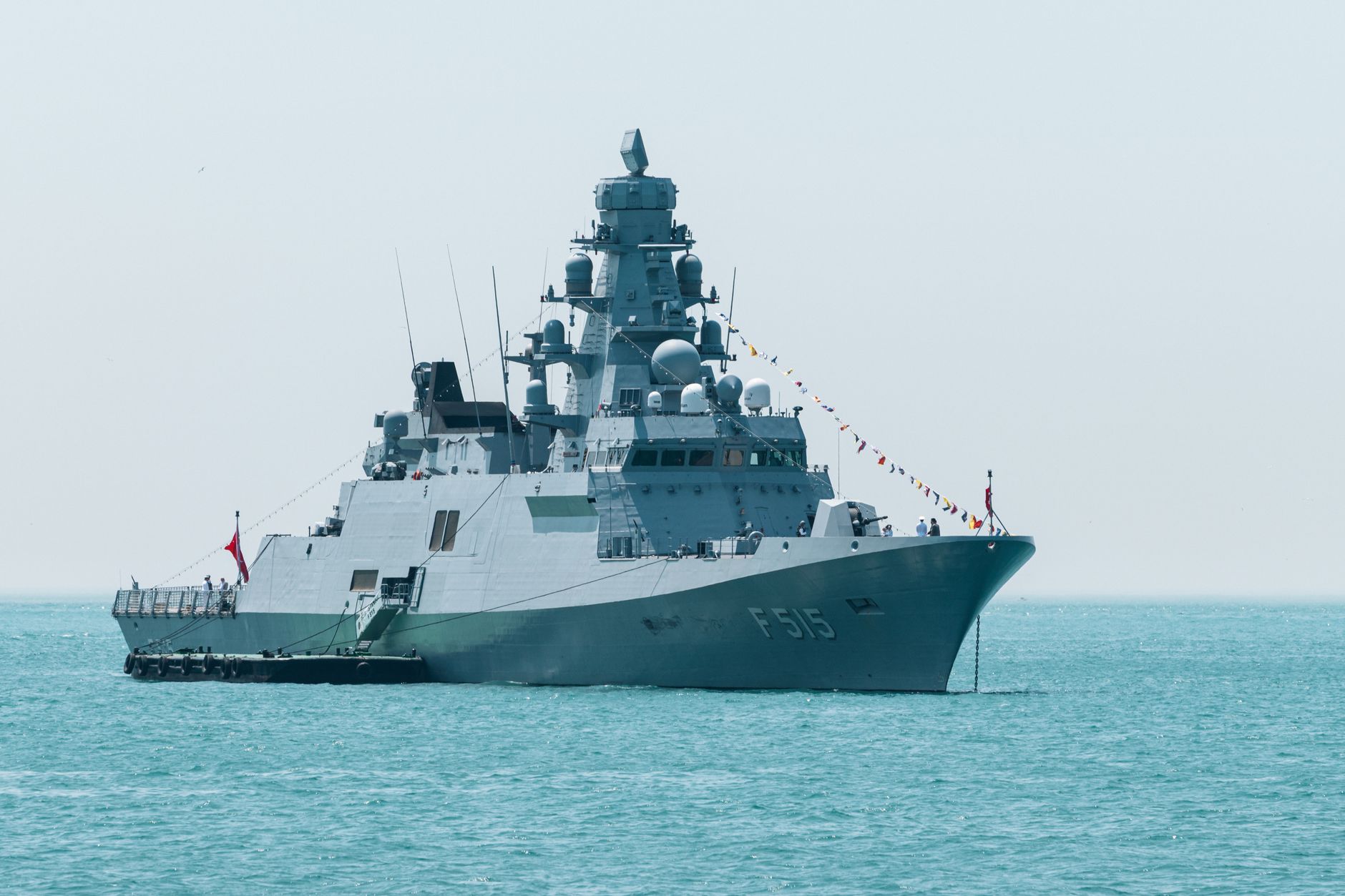
The US naval presence at Yokosuka has anchored Pacific deterrence for eight decades — a guarantee Japan's leadership now treats as insufficient.
K / PexelsThe Numbers That Made the Speech Inevitable
Japan spent roughly 0.9 percent of GDP on defense for most of the past three decades — a self-imposed ceiling that tracked the spirit of Article 9 even as successive governments stretched its legal interpretation. In 2022, the Kishida government committed to doubling defense spending to 2 percent of GDP by 2027, aligning Japan with NATO’s benchmark figure for the first time in its postwar history.
The budget trajectory since then has been linear and accelerating. Japan is acquiring Tomahawk cruise missiles — an explicitly offensive capability that would have been constitutionally unthinkable a decade ago. It is developing a counterstrike doctrine that allows it to hit enemy missile sites before launch. These are not defensive postures with aggressive-sounding names. They are offensive military capacities grafted onto a state whose constitution still formally prohibits them, pending a reinterpretation that the ruling Liberal Democratic Party has been engineering in increments since 2015.
Koizumi’s BBC interview is the rhetorical punctuation on a structural transformation already underway in the procurement ledgers.
Japan Defence Budget as % of GDP
What the Neighbors Are Calculating
South Korea and China occupy opposite positions on Japan’s rearmament, but neither position is comfortable. Seoul has operational reasons to welcome a more capable Japanese military — the two countries share threat perceptions on North Korea and are embedded in the same American alliance network. But South Korean public opinion carries the full weight of the colonial period, and any Japanese military expansion that is not carefully managed diplomatically risks activating that history in ways that destabilize bilateral relations Washington needs to keep functional.
Beijing’s calculus is simpler and more dangerous. China has consistently framed Japanese rearmament as evidence of its own threat narrative — that the United States is constructing an Asian NATO designed to contain China. Every percentage point Japan adds to its defense budget and every offensive capability it acquires feeds that narrative and provides internal justification for Chinese military expansion. The feedback loop is not theoretical. It is already running.
The Pacifism Question Is Now Settled
The debate over whether Japan should rearm is over. The rearmament is happening. The debate that remains is constitutional, diplomatic, and architectural: how Japan integrates its expanding military capacity into regional relationships without triggering the escalatory dynamics Koizumi claims rearmament is designed to prevent.
That is not a simple problem. States that rearm to deter war have a structural interest in making their capabilities credible — which means making them visible, which means making neighbors nervous, which means generating the threat perceptions that produce the arms races and miscalculations that deterrence is supposed to forestall.
Koizumi’s framing — rearm to prevent war — is not wrong as a matter of strategic logic. But it omits the mechanism by which that logic fails. Japan is not rearming into a stable environment. It is rearming into a region where three nuclear-armed states have overlapping and unresolved territorial disputes, where American commitment is a variable rather than a constant, and where the institutional frameworks for managing military competition are thin.
The postwar order in the Pacific was built on Japan’s strategic self-restraint. That restraint is now classified as a vulnerability. What replaces it will define the region’s security architecture for the next generation — and no one has yet produced a design.