The Announcement and What It Actually Means
Iran has declared its intention to impose a ‘payment for services’ on vessels transiting the Strait of Hormuz. The language is bureaucratic by design. Framed as a service fee rather than a blockade or a tariff, Tehran is attempting to establish a legal and operational precedent that sidesteps the international law frameworks that would otherwise classify such an act as piracy or an act of war.
The Strait of Hormuz is 21 miles wide at its narrowest navigable point. Approximately 21 million barrels of oil pass through it daily — roughly one-fifth of global petroleum supply. Every major Asian economy, several European states, and significant portions of global LNG trade depend on unimpeded passage. Iran does not need to close the strait to inflict economic damage. It only needs to make closure credible enough to move markets, and any toll mechanism does exactly that.
The Mechanism of the Toll
The precise fee structure has not been published. That ambiguity is not an oversight — it is the instrument. A vague toll creates maximum discretionary power for Iranian authorities to apply pressure selectively: exempting friendly-flag vessels, targeting adversaries, and building a patronage architecture around Hormuz passage that mirrors the leverage China exercises over rare earth supply chains.
Shipping insurers will respond before any vessel does. War-risk premiums on Hormuz transits were already elevated following the 2019-era tanker incidents and the 2024 Houthi disruptions in the Red Sea. An Iranian toll announcement, regardless of enforcement capacity, triggers immediate reclassification of regional risk. That feeds directly into freight costs, which feed into refined product prices, which transmit into inflation at the pump across Asia and Europe within weeks.
The Iranian state does not need the toll revenue. What it needs is the institutional fact of a toll — the acknowledgment by other states that Iran possesses and exercises sovereign pricing power over a global commons.

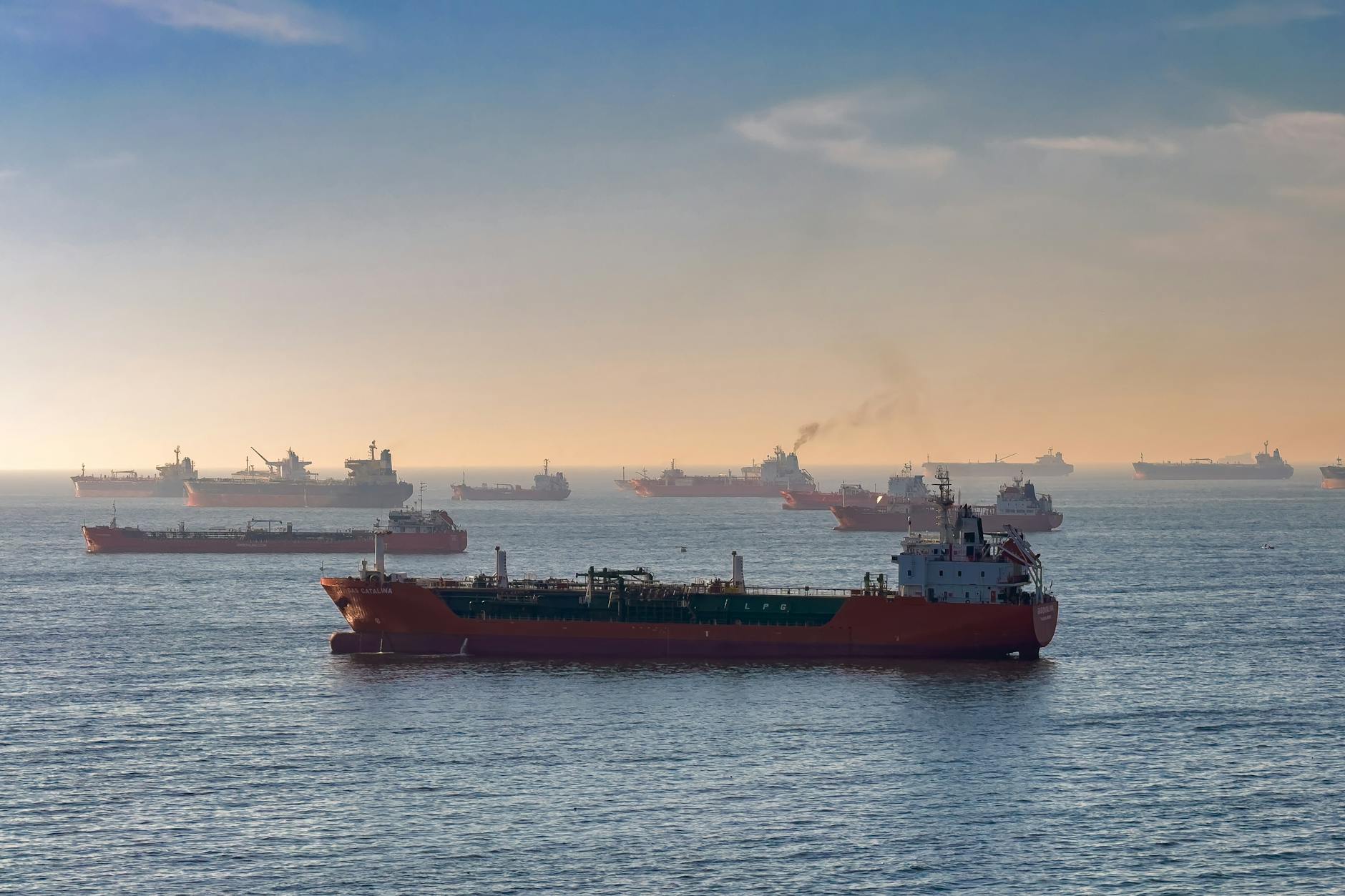
Iran's coastline flanks the northern edge of the Strait, giving Tehran de facto leverage over every tanker transiting the world's most critical oil corridor.
Zifeng Xiong / PexelsWho Bears the Cost
The distribution of exposure is not uniform. China imports approximately 6.2 million barrels per day through Hormuz. India imports 2.8 million. Japan and South Korea combined account for nearly 4 million. The United States, having substantially reduced Persian Gulf imports through domestic shale production, sits at roughly 600,000 barrels per day — a fraction of its Asian counterparts.
This asymmetry gives Tehran structural leverage over the economies most critical to any sustained international coalition against Iran. Beijing’s dependency is not incidental — it is Iran’s primary diplomatic insurance policy. A toll that raises costs for Chinese refiners creates pressure on Beijing to shield Iran from multilateral consequences rather than join in applying them.
European states, already managing energy cost volatility following the Ukraine war and the partial decoupling from Russian gas, face compounded exposure. Any Hormuz premium layers onto infrastructure that was already strained.
Top Hormuz-Dependent Oil Importers (million barrels/day)
The Legal Architecture Iran Is Attacking
The 1982 UN Convention on the Law of the Sea guarantees the right of transit passage through international straits used for international navigation. The Strait of Hormuz qualifies unambiguously. Iran has never ratified UNCLOS, a position it has maintained precisely to preserve legal maneuverability in situations like this one.
Oman controls the southern shore of the strait. The UAE’s coastline sits adjacent. Neither state has the military capacity to enforce freedom of navigation against Iranian action, and both have significant economic relationships with Tehran that constrain their willingness to become the frontline of a confrontation. The United States Fifth Fleet, based in Bahrain, is the practical guarantor of transit passage — and Tehran’s announcement lands at a moment when Washington’s strategic bandwidth is stretched across simultaneous commitments in Ukraine, the ongoing Israel-Lebanon-Iran diplomatic architecture, and domestic political turbulence.
A Precedent That Cannot Be Contained
The deeper structural problem with Iran’s announcement is not the fee itself but the logic it introduces into international waterway governance. If Tehran successfully establishes that a state controlling one shoreline of a strait can charge toll for passage, the template becomes available to any state in an analogous geographic position.
Malacca, Bab el-Mandeb, the Turkish Straits, the Danish Straits — each has a coastal state with political grievances, economic pressures, or authoritarian incentives to convert geographic position into revenue and coercive leverage. The Hormuz announcement is not an isolated provocation. It is a stress test of the post-1945 framework governing the global commons, conducted by a state that has calculated, accurately, that the enforcers of that framework are currently distracted, divided, and politically costly to mobilize.
The international order governing maritime passage was built on the premise that no single state could toll the sea-lanes. Iran is now testing whether that premise still has teeth.